THE PURSUIT OF FAIRNESS WILL ONLY MAKE YOU UNHAPPY
Why meeting needs beats keeping score

Fairness sounds like a noble goal
Treat everyone the same, divide everything evenly, play by the rules, keep the scales balanced. But in a family, chasing fairness will wear you out and leave everyone less satisfied. That's because fairness and meeting needs are not the same thing. They often point in opposite directions.
In a family, the real work is understanding what each member needs. That includes the parent. This is part of why the parent is the leader. The parent can see from a higher level. They can take in the needs of every person in the home, including their own, and respond to what's actually there instead of running everything through a fairness calculator.
Here's what that looks like in practice.
Fairness in dividing things up
Picture one pizza and two kids. One is 3 and one is 12.
Fair means you cut the pizza in half and give one half to each kid. Equal portions, case closed.
Meeting needs means the 3 year old gets a slice and the 12 year old devours the rest. Both kids walk away with their hunger met. The 3 year old didn't need half a pizza. The 12 year old needed more than half. Nobody was shorted, because the goal was never equal distribution. The goal was two fed kids.
When you divide by fairness, you end up with a hungry 12 year old and a plate of wasted food in front of a toddler. When you divide by need, everyone gets enough.
Fairness in games
This one matters more than people realize.
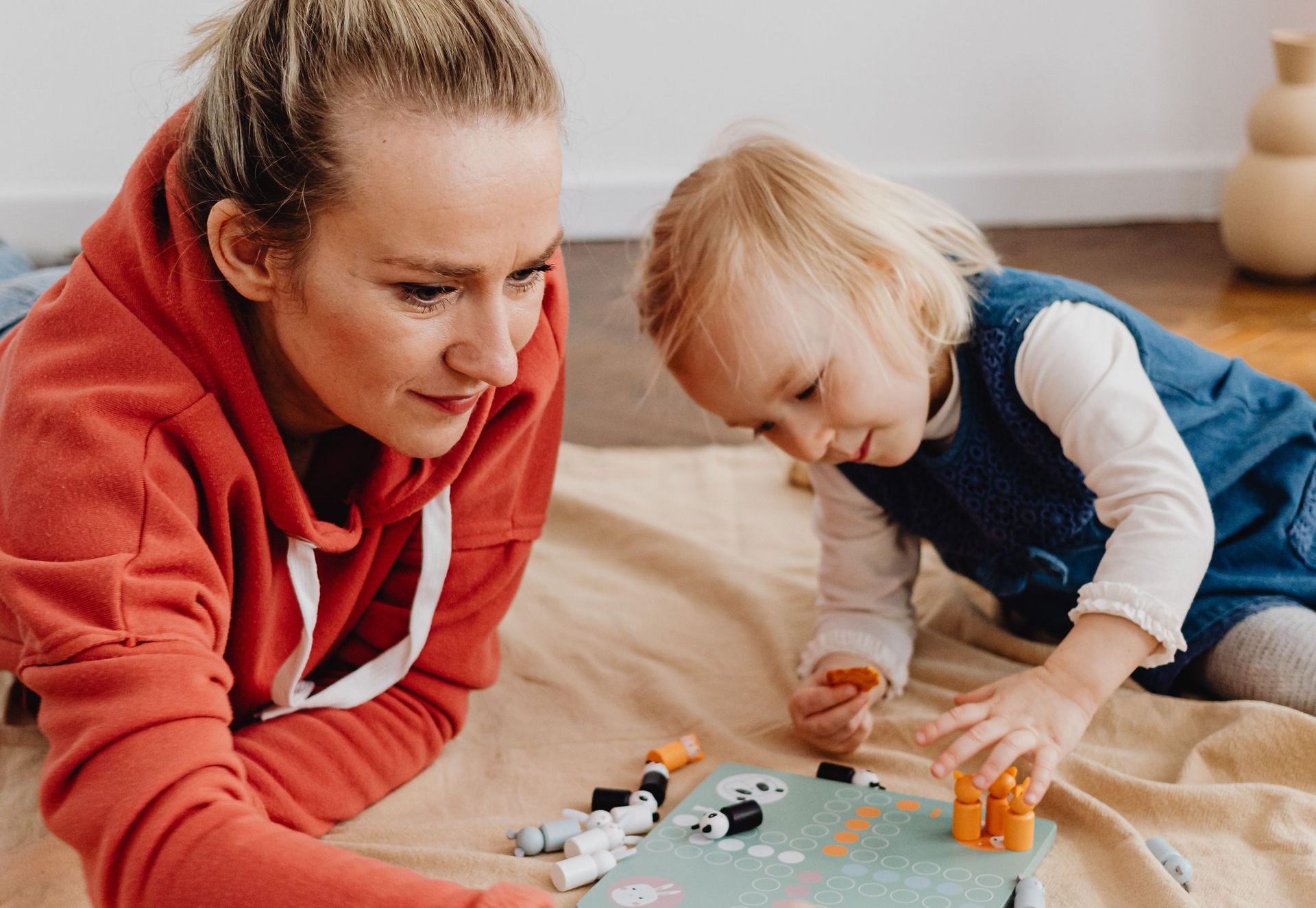
Fair means we play the board game by the rules. But a young child learning competition has a different need. Somewhere in the 2 to 5 range, and sometimes later if this work got skipped, kids need room to bend the rules, change the rules, and manipulate the game as they sort out winning and losing. Losing is intensely uncomfortable for them, and they need to approach it at their own pace.
I hesitate to lock this to an age, because a child who never got this experience will be older and still falling apart over losing, still obsessed with what's fair. The need doesn't expire. It just waits.
So when it's an adult playing with a young child and the focus is on the child learning through play, fairness gets set down. This changes when several kids of different ages are playing together, but one on one, the rules are flexible on purpose.
Say a child races you to the car. If I know the child's desire is to win, I'm not touching that car first. But suppose I do, and the child says, "I won because you have longer legs and faster shoes." I'd say, "Oh, you won that round because I have longer legs and faster shoes. I see. That was fun, should we play again?"
I'm not correcting the logic. I'm not driving home a lesson about rules. The child is leading an exploration, little by little, into the land of losing. My job is to model losing (showing them through my words and demeanor, "I lost and I'm okay, still my awesome self"), and to let them win when losing would be too much too soon.
With young children, the goal isn't to teach the value of sticking to the rules. There will be plenty of time for that. The goal is to gain experience losing while holding on to your worth. And that gets modeled before it gets practiced. The adult goes first, losing over and over while showing, "I lost and I still love myself. I'm still worthy of love." When a child sees that enough times, they start to dabble in losing themselves.
My boys, at 4 years old, ran competitive experiments, each in his own way. One of them would set up pool races where he decided in advance who would win, who would lose, and exactly how each of us was supposed to react when it was over. He was writing the script so he could study it from a safe distance. The other built a race car game that ran on pure luck. Cars got tossed, and whichever one landed on its wheels won. Chance handed him plenty of losses, and it handed me wins and losses right alongside him. You could read the struggle in his whole body when his car didn't win. But the game also gave me a stage. I cheered for him. I rooted for his car. When he won, I was genuinely glad. No teasing, no rubbing it in. Then one day he cheered for me. My win had become his win.
If your child melts down when they lose or gloats when they win, that's information, not a character flaw. It tells you their self worth is still tied to the outcome. The work is the same: model losing, and show them that the person who lost is the same awesome person who sat down to play.
And in case you were wondering, losing sounds a lot like winning.
Losing sounds like: "Nice job. That was so fun. You did great. Can't wait to play again."
Winning sounds like: "Nice job. That was so fun. You did great. Can't wait to play again."
Give it time and you'll hear your child say the same things when they lose.
Fairness in buying things
Buying something for one member of the family doesn't mean buying for all of them.
Brother needs new shoes. Sister doesn't. Fairness says you'd better grab her a sweater or something so it evens out. Meeting needs says brother gets shoes, sister gets empathy.
"Ugh, it's hard to see brother get new shoes when you don't. When you need shoes, I'll buy them for you."
Then let her feel it. Envy is just an emotion. He got something and I didn't. That's hard to feel. I wish I needed shoes too. A child who gets to practice feeling that, with a steady parent nearby, builds something that will serve them their whole adult life. Adulthood is full of moments where someone else gets the thing and you don't. The people who handle those moments well got their reps in early.
When you buy the sweater to balance the scales, you're not soothing her. You're teaching her that envy is an emergency that someone else needs to fix, and you're signing yourself up to balance every purchase for the next fifteen years.
Fairness in conflict
This might be where the pursuit of fairness backfires the hardest.
Two kids are fighting over a toy and the parent steps in as referee. We gather the facts. Who had it first. Whose turn it is. How long each kid has had it. Then we hand down a ruling designed to nail "fair," and we wonder why nobody's satisfied. The kid who lost the ruling feels wronged. The kid who won learned that the way to get what you want is to win the parent over. And both kids learned the same lesson: conflict is something a referee resolves, not something they resolve.
That's the real cost. Every time we rule on a dispute, we take a rep away from our kids. Conflict resolution is a skill, and like every skill, it's built through practice. A kid who spends childhood having disputes settled by a judge arrives at adulthood having never practiced. Then they hit a roommate conflict, a marriage conflict, a workplace conflict, and there's no referee coming.
So the job isn't to determine fairness. The job is to help each child express what they need, then get out of the way while they find something that works.
That sounds like: "You want a turn and you're tired of waiting. Hmm, what could we do?" One of them might say, "Let's do a timer for every 10 minutes." The other might say, "That's way too long, let's do 5." "Fine, we can switch every 5 minutes."
Here's the part that takes some swallowing: their solution might look completely unfair to you. One kid trades five minutes with the toy for the other kid's entire dessert. One agrees to go last every time in exchange for picking the game. You watch the deal go down and every fairness instinct in your body starts twitching. Let it twitch. If the solution works for the two of them, it works. They're not solving for fair. They're solving for what each of them actually wants, and they know what they want better than you do.
Resist the urge to renegotiate their deal into something more balanced. The moment you do, you've told them their solution wasn't good enough and the referee is back on duty. You also miss what just happened: two kids identified their own needs, expressed them, and found a trade that met both. That's the whole skill. That's the thing adults pay mediators and therapists to help them do.
Your role shrinks over time, and that's the point. Early on you're translating: "It sounds like you want this and he wants that." Later you're just nearby. Eventually you hear the negotiation happen from the other room and you didn't get called in at all. A parent chasing fairness never gets to that room. The referee always has another case on the docket.
The word that never took root
We don't use the word "fair" in our house. Not as a stated rule. Nobody banned it. It just isn't vocabulary we use, because nothing in our home gets framed as fair or not fair.
That's worth sitting with. Kids don't come out of the womb saying "that's not fair." They learn it. They pick it up when the adults around them frame the world as a ledger, when every slice gets measured and every purchase gets balanced.
To the best of my ability, I frame things around needs. I wonder: What's the hunger need? Who needs shoes? Are they ready to lose? When that's the framework a child grows up inside, "fair" has nothing to attach to.
What you're actually after
Fairness is a moving target you can't hit. There's always a way to measure things where someone got more. Kids who are raised on fairness become expert auditors, tracking every slice, every turn, every dollar, and they're rarely satisfied, because the scales never feel level from the inside.
Needs are different. Needs can actually be met. A fed kid is fed. A child who got to win at 4 grows into one who can lose at 8. A kid who felt envy and survived it stops fearing it.
So set down the scale. Look at each person in your home, including yourself, and ask the better question. Not "is this fair?" but "what does this person need?" One question keeps you keeping score forever. The other one lets everyone in the family actually win.